Showing posts with label Memories. Show all posts

Saturday, 22 February 2020

#52Ancestors, Favourite Photo


When this topic has come up in the past I have chosen a family group photo to discuss.  

This time though I have chosen a landscape - actually three. 
I have hundreds, thousands of photos; landscapes, sunsets, flowers, trees, people, buildings, holiday memories, instagram gold.


I love these though because they are timeless. 

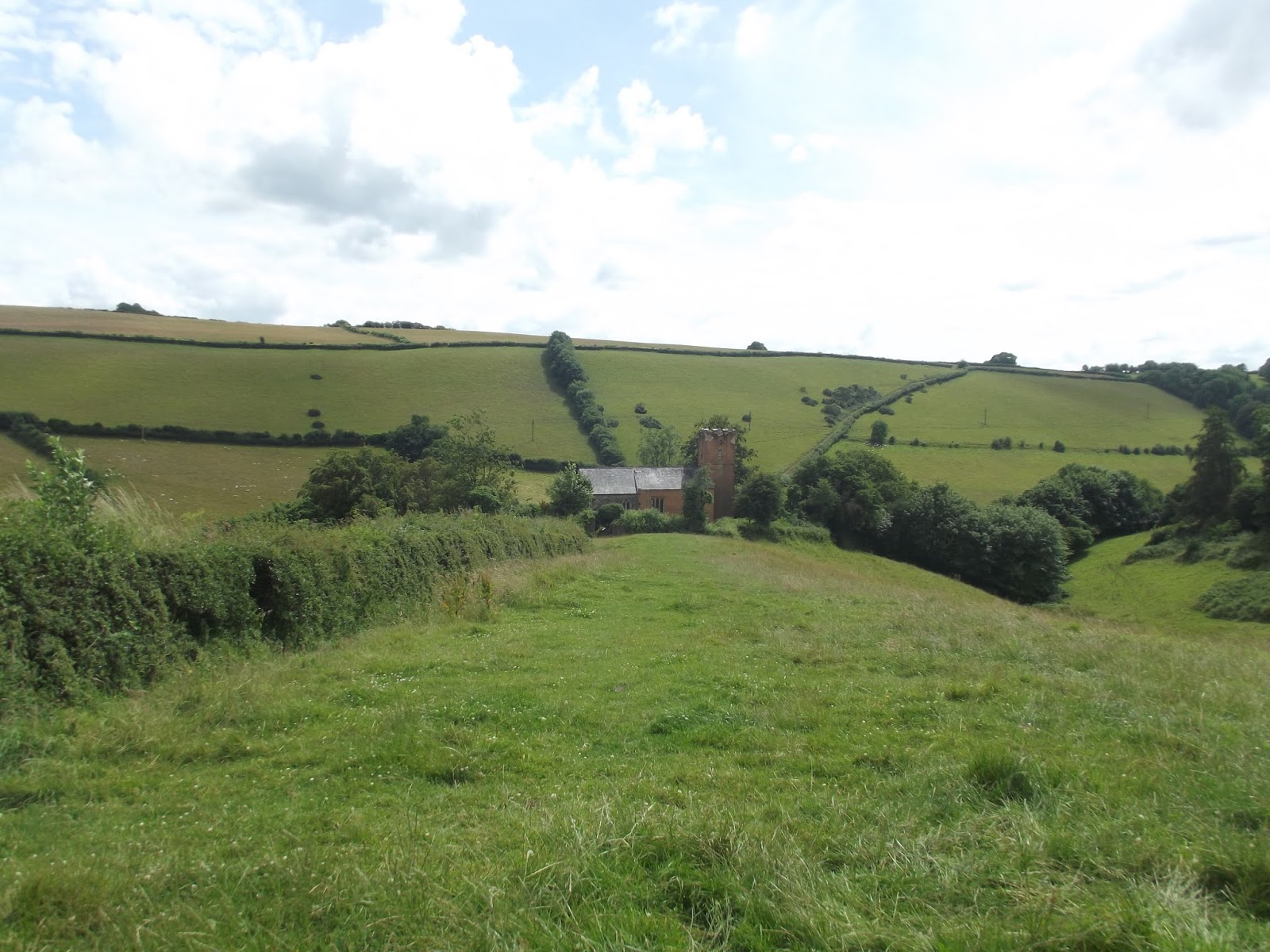
It is the view I savoured (and photographed) just six years ago. It is exactly the same view that my great great grandparents and their children saw, and will have remembered, every day in the years leading up to their departure from England for their fresh start in New Zealand. Although there were probably more apple trees planted in the orchard in the foreground then.

It is the same view that the original inhabitants of the house and farm would have seen hundreds of years before them.


And this, from the gate at the top of Churchill looking down to St Michael's Raddington. 
Unchanged. 

The Manor House, Kingston, at the foot of the hill where my great great grandfather lived with his elder brother, their mother, stepfather and half siblings. Where their father and grandfather had likely lived before them. St Michael's where his grandfather's brother had been the minister until 1783 and his grandmother's great grandfather or his brother was church warden in 1675.

It is where I feel at home, although I never lived there. Being there feels grounding, walking in the footprints of my ancestors. It’s in my DNA.

Tuesday, 2 October 2018

#52Ancestors, Week 39, On the Farm


There were lots of farms in different branches of my family. Sheep farmers, dairy farmers and orchardists. I remember going to visit some of Dad’s aunts who lived on farms near Hamilton, but only to visit for afternoon tea, on our best behaviour.

In February 1965 my grandmother remarried, to a farmer from Southland who had been a bachelor up until then. They had met on a cruise which Nana had gone on with a couple of her sisters and their husbands – part of a group of members of Federated Farmers. (Hope I have these bits right).


 Anyway, after they married Nana moved with Bert to his farm at Spar Bush, near Invercargill. SO far away from her family, sisters, nieces, nephews, sons and grandchildren. We stayed in contact by writing letters – well Mum and Dad did more than us. We also used to record our news on to Dad’s reel to reel tape recorder and they’d be packaged up and posted to Nana – then we would get one in return from her.


In December 1965, we left on the biggest school holiday trip we had ever had. I am sure I remember coming home from school and Mum was packing the car, shoving bits into little nooks and crannies. I think it might have been raining. I can’t remember though whether we left after Dad came home from work and drove to Whakamaru to stay with Nana and Grandad, or whether we left really early the next morning. I do remember though, that we stopped for a breakfast picnic by the side of Lake Taupo; at Mission Bay. Was this the time Dad forgot to pack his razor ? Or did Mark forget his jammies ?

Anyway, we went all over the place – we had Christmas in the snow at Milford Sound, and then went and stayed at Nana and Bert’s farm. I don’t remember too much about the operation of the farm at all. There was milking happening in the cowshed next door, on a farm run by one of Bert’s grand nephews. Their son Robert used to come to see us when he didn’t have work to do around the farm. His parents – or perhaps the people on the next farm – had Shetland ponies which I remember going to see one afternoon.

There was a monster vegetable garden, and sheep and cattle. And the kitchen seemed enormous with windows looking out to the farm and the morning sun pouring in.

Bert had a sheepdog, Tip. I suspect from other holidays there that there were different dogs, but they all seemed to be called Tip. Bert could whistle instructions to him so that he would round up the sheep and direct them to the paddock or pen that he wanted them to move to. There was a fluffy cat too – named Fluffy. She seemed to have kittens in tow each time we visited.


 One night a bull got through the gate and into the vegetable garden. I remember a bit of consternation among the adults, but he was steered back to the correct paddock and the beans and peas were a little worse for the wear on inspection in the morning.

So there you have it – on the farm. There is probably more, but it is all a bit muddly in my memory so I will need to spend some time getting it all into chronological order for another time.

Thursday, 10 May 2018

#52Ancestors, Week 17, Cemetery


I’m not sure why, but I like wandering through cemeteries. The first one I remember going to was Hamilton East, with my Dad one evening. That memory stuck with me and I was able to relocate the resting place of my great-grandparents with not too much difficulty some 45 years later.

Wandering around churchyards and cemeteries is common place for many genealogists, so there are a number of special places I have come across.

One which I especially enjoy wandering through is Bolton Street in Wellington. On the side of a hill rising above The Terrace, it is one of the oldest cemeteries in Wellington and consequently is the resting place of many early settlers.

In the 1960s part of it was dug up and the graves re-interred to make way for the motorway which now runs relentingly through the middle. A pedestrian bridge crosses above the motorway so that you can walk down from the Seddon Memorial near Anderson Park and the Botanic Gardens, or up the hill from the Bolton Street entrance where the chapel and sexton’s cottage stand.

My great great great grandparents are buried there, or at least memorialised on the headstone for one of their sons. Others too, sisters of my great great grandmother. Most are in the new memorial lawn where a lot of the re-interred souls were buried. A bench sits near this site, behind the chapel commemorating the arrival of the Barratt family (my great great great grandparents) in Wellington in 1842.


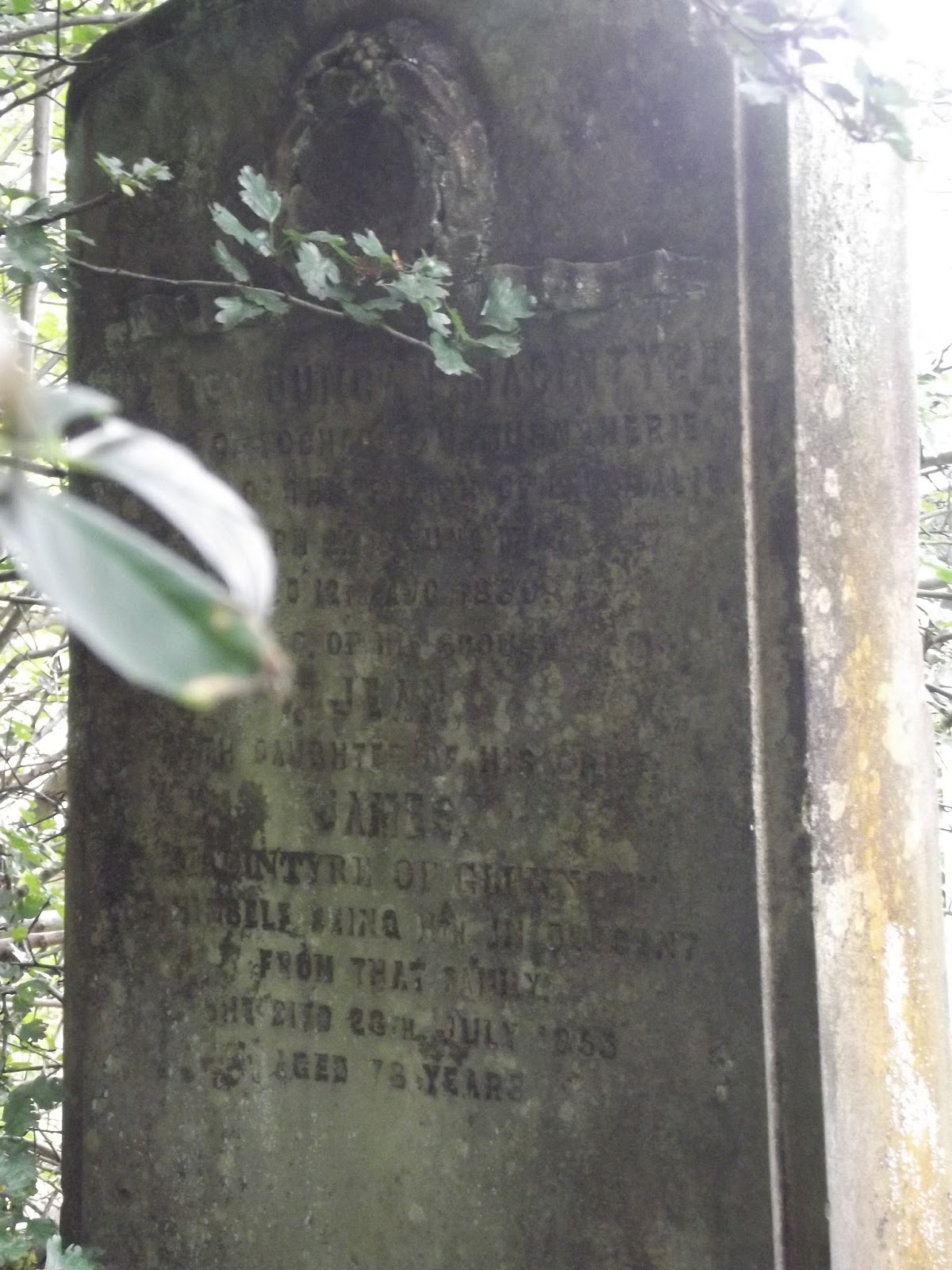
The cemetery at Kilmaillie near Fort William, Invernesshire was one we explored while in the UK in 2014. We went early one morning and wandered in the dewy grass looking for a headstone with McIntyre on it. There were quite a number of them, and Cameron too since we were at the heart of clan Cameron country.

Finally, there it was. Almost obscured by trees which have been growing for almost 200 years. Lauren’s great great great great great grandparents. Reverend Duncan McIntyre of Lochaber, Camusnaherie (Rev of Kilmaillie) 1757-1830 and his wife Jean, the daughter of James MacIntyre of Glen Noe – the 3rd of that family 1777-1855.

very hard to read in the shade - will have to go back again I guess, one day.

A bit of Scots royalty there – Jean’s great grandfather was Ewen “Dubh” Cameron, Locheil 1629-1719.

Also spotted there, this one !


In Memory of John Telford, first engineer on the western end of the Caledonian Canal. That amazing engineering feat which includes Neptune’s Staircase and was designed by James Telford. John and James are thought not to be related. The work was difficult and detrimental to his health and he died in 1807, fifteen years before the canal opened. There is more about the construction and some photos of this grave (referred to as dilapidated but not looking as overgrown as my photo) here.

Next on my list – Melbourne General Cemetery, to see if I can locate the resting place of my great great grandmother.

Sunday, 29 April 2018

#52Ancestors, Week 16, Storms


I love a good storm. Right now I am missing them a lot. Where I live currently, they don’t seem to get anything except blue sky and incessant sunshine.

My Mum talks about some storms she remembers when she was a child. So, I thought I’d see what I could find in newspapers about them.

There are several events which occurred in the short time they lived at Highbank, near Methven, Canterbury. They had moved there in early 1943. My grandfather had been working at Waitaki Power Station near Kurow during the final stages of construction and then for almost nine years after it was commissioned and opened.[1]

Their relocation was linked to his job, and the construction of the Highbank Power Station. Highbank sits by the side of the Rakaia River near Methven. The intake to the power station comes from a diversion to the Rangitata River, down the hill in the pipeline to the station and then the tailrace takes the water to the Rakaia.[2]

I found some notes of Mum’s that augment my memory of the stories she has told us, and I have also spent some time searching on PapersPast to see what I could find to establish the exact dates. Some of the events don’t appear to have been reported at all – or more likely haven’t yet been digitised. (How I wish the National Library of New Zealand would adopt the model for digitising used in Australia by Trove).

During the night of February 22nd, 1945 floodwaters on the plain above Highbank breached the wall of the diversion channel and water poured down the hill to the station.[3] The overseer was awoken at 3am to the noise and rallied a team together who worked against time in the wind and rain to build a stopbank in an endeavour to save the power house and pipeline.[4] While the power house was saved, the slip still happened, racing down the hill; almost completely destroying the access road and burying 5 of the 7 houses in the village below. Remaining men and wives and mothers gathered their children and made for the relative safety of the power house. Afterward, women and children were sent away for a few days while the clean-up ensued. Mum went with her siblings and mother to stay with their grandmother in Christchurch. 

The station had been scheduled to open in March, but this was delayed so that the road could be repaired and the clean up completed.[5] All of the shingle needed to be dug out of the houses; drapes, furniture, carpet and belongings cleaned. Cars too, buried in the pile were dug out and stripped down, cleaned and reassembled.[6] Temporary housing was supplied as well, while a new village was constructed on the valley floor a little way from the power house.

Bert Fuller, Highbank slip damage to housing, c23 February 1945, digital image, personal collection.

Bert Fuller, Highbank slip damage construction village and river plain, c23 February 1945, digital image, personal collection.

In Mum’s notes a bailey bridge was installed at this time, which would make sense with the road gone.[7] This enabled the school bus to come down to the construction village to collect the children and take them to school in Methven. Before this, they needed to walk up a zig zag path to the top of the hill. However, the only newspaper account I have found mentioning the bridge, documents its removal in March 1945, having been put in place to give construction workers access following a washout before Christmas.[8] But perhaps it was a separate bridge to the one required after the slip and which features in photos belonging to my grandfather.

Bert Fuller, Highbank Bailey Bridge, cFebruary 1945, digital image, personal collection

Bert Fuller, Highbank Bailey Bridge, cFebruary 1945, digital image, personal collection.

The next storm, also involved a night time move to the powerhouse, so infers that it occurred before the village was relocated further down the valley. (Maybe not ? I may need to make some corrections in the future.) Families were awakened by the wind roaring through the valley, as they are apt to do in Canterbury.

“In a small construction cottage, wind tore through the gap under the door, rattled at the windows. Suddenly a tremendous roar; the roof peeled off and was hurled through the air. The windows blew in, shattering glass everywhere.”[9]

Removed to the relative safety of the powerhouse, the quiet was soon disrupted by the fury outside when another gust blew the huge roller door in like “a piece of paper”.[10] What a sight in the morning, toppled trees, roofless homes, curtains flapping in the breeze, torn.[11] I can’t find any account of this storm in online newspapers at all, or none that truly connect a gale to these events.

The other event much talked about was a big snowfall. I had always imagined this was the 1945 snowfall which is often compared with recent falls.[12]

unknown, Edith Fuller at Christchurch, cJuly 1945, digital image, personal collection.

But, I think from looking at photos and reading the old papers, that it was most likely in 1943.[13] That snowstorm was compared, at the time, to heavy falls in 1918.[14] Mum and her family were in Christchurch, visiting their grandmothers when the snow came.[15] Her father needed to get back to Highbank for work, but driving was not possible. He travelled by railway jigger to Methven and was met by a farmer who lived near the top of the access road. The road was not passable, so he walked/clambered down the hill alongside the pipeline (or where the pipeline was being constructed) to the power-house.[16]

 Bert Fuller, Methven Hotel, cJuly 1943, digital image, personal collection

 Bert Fuller, Highbank Power House from top of the pipeline, cJuly 1943, digital image, personal collection.

 Bert Fuller, Highbank construction village, c July 1943, digital image, personal collection.

Bert Fuller, Top of access road, cJuly 1943, digital image, personal collection.

unknown, workers at Highbank, 6 July 1943, digital image, personal collection.

The idea of travelling by jigger was met with some envy by Mum and her siblings; and with fascination by us hearing the story. But I bet it was freezing cold, and not actually that much fun at all – you’d keep warm though keeping it moving I suppose.


[1] NZ History, ‘Waitaki Dam’, https://nzhistory.govt.nz/media/photo/waitaki-dam, Accessed 29 April 2018.
[2] Unknown, Highbank Power Station, R.E. Owen, Government Printer, Wellington, New Zealand, 1965, pp.1-4.
[3] Damage at Highbank, Houses Buried In Shingle, Press, 24 February 1945, p.6.
[4] Saved Power-House, Evening Post, 3 March 1945, p.8.
[5] Saved Power-House, Evening Post, p.8.
[6] Elisabeth Davys, The Years from 0-10, circa 1974, original held in author’s possession.
[7] Elisabeth Davys, The Years from 0-10, circa 1974.
[8] General News, Bailey Bridge Dismantled, Press, 27 March 1945, p.4.
[9] Elisabeth Davys, Wind, circa 1974, original held in author’s possession.
[10] Elisabeth Davys, Wind, circa 1974.
[11] Elisabeth Davys, Wind, circa 1974.
[12] Christchurch Libraries, ‘Snow Days’, https://my.christchurchcitylibraries.com/snow-days/, Accessed 29 April 2018
[13] The Snowstorm, Press, 10 July 1943, p.3.
[14] The Snowstorm, Press, p.3.
[15] Elisabeth Davys, The Years from 0-10, circa 1974.
[16] Elisabeth Davys, The Years from 0-10, circa 1974.

Sunday, 22 April 2018

#52Ancestors, Week 15, Taxes


Well, this one has been taxing to say the least ! So much so that I am well into Week 16 and still deliberating. Should I look at people who paid land taxes or poll taxes ?

I don’t recall there being any accountants or tax collectors…maybe an excise man (but I think he was very much on the periphery of the tree), so perhaps someone who has been taxing to research ?

I’ve recently been writing about an object for one of the units in my Diploma and was reminded about tariffs on imported goods and how difficult the government made it for people as late as the 1970’s in New Zealand to import items such as cars. How ridiculous when they didn’t really have a domestic market that they were trying to protect.

Anyway, it just reminded me that this affected other imported goods too. New technology that people were wanting to purchase to be a part of the tech boom beginning to happen. One such invention was stereo players.

I don’t remember if we had a “sound system” before this one or not. Perhaps we did. My grandparents had the radiogram which I wrote about for Week 8 – Heirloom. Before stereo sound there was only mono.

Anyway, a stereo was what was wanted, but the cost to import one, or buy one from a store was pretty extravagant in late 1960’s New Zealand. So what to do ?

Build your own, of course.

Dad and some friends hatched a plan (as I recall) and would order the components required to be delivered to one anothers’ homes. Then they would get together, sometimes in the lounge room at our house, or individually and sort bits. I will probably get all the names wrong, but there were transistors, diodes, valves and others with their little wire legs to get soldered (in the correct places) onto a circuit board, to build an amplifier. The case had to be made too I think, and all the knobs and decals to be added so that you knew which was on, off, volume etc. Then start again, this time a turntable.

Then there were the speakers, they were bought too; and the speaker boxes built and assembled at home, lined with insulating batts. They were BIG speakers, plus a smaller woofer, nothing like the teeny ones in today's mini systems.

I’m not sure how long the whole process took, from inception and design to completion, but it was done. Take that Mr Tax Man !

Then came the music. Albums were often purchased by catalogue and would arrive packed in cardboard packages, delivered by the mailman. Acker Bilk, Herb Albert & the Tijuana Brass, Louis Armstrong, The Seekers, Gary Puckett and the Union Gap, Henry Mancini, Frank Sinatra, soundtracks to Sound of Music and Oliver, Peter and the Wolf, the classics; symphonies and the like – and MOOG music !

How much simpler it is now and how much more accessible these items are to purchase. But what a sense of accomplishment to build your own.

Sunday, 8 April 2018

#52Ancestors, Week 14, The Maiden Aunt


Tricky subject this one. I can only think of three. One who I met, but don’t know too much about, and two who I heard about; but only one who I have researched.

She was a mythical relation when we first began researching, but actually turned out to be the key to so many more discoveries. When we finally solved HER puzzle.

Elizabeth James, born 1 May 1846 at Broadward Bridge near Clungunford was the eldest child of Henry James and his wife Ann Thomas. They had married in Brimfield in 1843. Henry was a gardener or green grocer most of his life from church records and census’. Henry was born in Bucknall, Herefordshire, Ann in Wales. On the 1851 United Kingdom census, her birthplace was transcribed as “Slangyowitch” – what ? A bit of deciphering and map searching, it turns out this must have been the enumerator recording the Welsh place name LLanymynech as phonetically as he could, and the Ancestry transcriber trying to make sense of his writing. Anyway, I digress.

By the time the 1851 census came around, the small family, now including Elizabeth’s younger sister Mary, were living in Dudley, staying with a Duffill family. The significance of this family would become apparent much later.

Elizabeth was my grandmother’s grand-aunt; the sister of her grandmother. Nana didn’t share a lot about her family. Just little tidbits to keep you interested. She spoke about this Aunt (Lizzie) fondly; admiring her “pluck”. Aunt Lizzie, Nana told us, was a pretty remarkable lady. She had gone to America on her own when she was seventy years old.

Two of Nana’s uncles had gone to America too, and it appeared that Aunt Lizzie had gone to join them. But things are never quite as they seem.

After the death of her sister Mary – also known as Polly – Elizabeth and her father took in Mary’s two young children at least until their father remarried eight years later. On the census’ her occupation is recorded as Dressmaker, in later years when her niece and nephew were no longer staying with her, she was living with her father. From the way Nana spoke about Elizabeth, I always felt she had known her, and that she had left for America while Nana was young.

A note left for his children by my 3rd cousins grandfather, my grandmother’s cousin, he wrote of how his family had left England to live in America when he was seven. Where they had lived in England, relatives in England or at least his memory of where they lived; who they stayed with on arrival in Boston and how they travelled to Seattle.

A Duffill family lived in Boston. Nana’s aunt and uncles had stayed with them after arriving in Boston, before travelling to Seattle. What was the connection we wondered. It transpired that the wife of Thomas Duffill on the 1851 census, where the James family had been recorded as lodging, was actually the younger sister of Ann (nee Thomas) James. She was an aunt of THIS Elizabeth. 

So some more research was done, and the same Duffill family, or parts of it were found living in Boston on United States census’ and other records. So, we thought, Elizabeth must have kept in touch with her cousins after they emigrated and facilitated a meeting with her nephews when they emigrated. Wrong again.

My American 3rd cousin was not aware of this aunt at all, she was also not aware of the 2nd uncle travelling to America – but that is another story. We searched and searched for passenger lists for Elizabeth James aged about 70 travelling to America. A needle in a haystack.

Perseverance though, and much research in to the wee small hours came through in the end. She wasn’t Aunt Lizzie at all, she was Aunt Bessie ! Furthermore she had emigrated earlier than we had thought. 1906. Nana wasn’t even born then ! This aunt who she had spoken of with such admiration was not someone she actually knew. But wait, there’s more. Her intended address on arrival in Boston ? The home of her brother-in-law Mr Duffill. What ? How could she have a brother-in-law when her only sister had married someone else and died almost 30 years earlier.

Well, this is how. Turns out she had an older half sister who had married into the Duffill family. Not marrying a cousin though, but a half cousin. Mr Duffill senior had at least five wives and children from each marriage bar the last. More research ensued and a letter was found by a descendant in a Bible, written by Elizabeth to her sister after the death of Elizabeth’s father in May 1905. This mentioned his burial “with mother” and inferred that he had assumed the role of father to her half sister. These half relationships get a bit tricky to keep track of, so apologies if you are lost.

So, when Nana’s aunt and uncles had emigrated a year later and stayed with the Duffill family in Boston, they will have been reconnecting with Aunt Elizabeth/Lizzie/Bessie, not just with distant cousins they did not know.

The connection that Nana, her brother and sisters had with their grand aunt must only have been by post. Most likely embellished by the memories of their own mother about her, during their very early years before she was taken from them.

Elizabeth James died in 1921 in New Hampshire having spent her last years living with the family of her half sister.


One of these remarkable ladies is Elizabeth James and one her half sister Ellen, exploring the sights of New Hampshire or Massachusetts in a magnificent car


Tuesday, 3 April 2018

#52Ancestors, Week 13, The Old Homestead


Two possible homes spring to mind as subjects for this topic.

Both of them, I feel should be heritage listed. But I think the current owners might have different ideas.

Along Northbank Road running next to the Wairau River, past Onamalutu and heading towards Tophouse and St Arnaud, on the opposite side of the braided river to State Highway 63, is Fabian’s Valley Road. It is not always open to the public and crosses private farm land. It is rough metal and at times verges on 4WD territory. Sometime before you reach Fabian’s Valley Road you will have crossed an unremarkable bridge over Bartlett’s Creek.

Still standing along Bartlett’s Road, past a small cemetery, is a cob cottage. Built, most likely in the early 1850’s. It is a survivor of large earthquakes including the Kaikoura 2016 7.8 quake and quite likely the Wairarapa 1855 8.2 quake, storms and timeworn neglect.

The first time that my parents visited was in the early 1980’s. They went with a cousin also researching the family, and met with yet more cousins still farming the land. At that time cattle called it home, and the work to try to save it was just beginning. I wish I could find those photos to include – maybe later.

In 2014, I went to see if I could find it too. It seemed much more cared for, although obviously used by locals who had left their beer cans behind. Sacrilege to us ! The cattle were still there, but kept away by a fence and the creek, which would have been their water supply was so close. I imagine at times it must have been INSIDE !


This was the home of my great-great-great-grandparents John and Maria Bartlett. They had left their home in East Chinnock, Somerset, where their families had lived for generations working as weavers, sailmakers and glovers, and bought their young family to Nelson New Zealand in 1842. Their youngest children including my great-great-grandfather were born in Nelson, in the Matai Valley. There are Bartletts still in the area, I believe, who are connected in some way to John and Maria. Maybe they were orchardists, apple growing was a big industry in pioneer Nelson and still is. Perhaps they were farmers.

At any event, something prompted them, and other families to move over to Marlborough in the early 1850s. Was it gold ? Was it simply the availability of land ?

The cottage itself has two rooms possibly three, judging by the remnants of a partition wall, downstairs. One obviously the kitchen still with an old coal range; a staircase leads to a loft space upstairs. Timber shingles are still on the roof in places, but most have been replaced by corrugated iron.


In this home Maria raised her family. The older children were now adults, some marrying in the district within the first years of their arrival. Others like my great-great-grandfather were still very young. Someone ran a school for the local children. Whether this was in their home or at another nearby location I do not know. I don't think it was Maria, more likely a daughter or daughter in law. When she and John were married in 1825, they had both signed their names with “x” on the marriage register.

Tragedy came to the family, not long after their arrival. On 19 June 1860 John was drowned in Spring Valley Creek while crossing it on his way home from a meeting. He had safely crossed the Wairau only to come to grief in the creek not far from his home. His son Joseph and son-in-law John Ward were following and found him. Three years later on 18 December 1863 another crossing went awry, this time on the Wairau River. It claimed the lives of son Joseph and son-in-law John Ward. They are described in the newspaper report as shearers and had crossed on horseback. John Ward’s horse arrived home rider-less which alerted family members to the catastrophe.


The river, which looks shallow, gentle and mesmerisingly blue normally, can be treacherous when in flood. Life goes on though for our pioneers, both young widows married again. Maria died just three years later. Her son Thomas, who had married his brother Joseph’s widow, stayed and raised his family there. His descendants were farming there still as recently as 2016, maybe even now.

Today, the large sheep runs and sheep farming as a whole are being overtaken by grapes and more grapes. This is Marlborough Sauvignon Blanc country.

Monday, 26 March 2018

#52Ancestors, Week 12, Misfortune


Misfortune. Lucky one week, unlucky the next ? A series of unfortunate events ?

Some years ago while doing some searching “alongside” my 4th cousin in the UK about the family line we share, and more particularly her branch of that line we came across a very sad discovery.

Two of my great grandmother’s cousins; brothers, moved their families from Wolverhampton to Glasgow around the turn of the century. The elder brother went first with his wife and young son between 1894 and 1897. About ten years later the younger brother followed with his wife and three young children.

Arthur and Martha (yes it’s true) had already lost one baby aged about eighteen months before travelling north. On the 1911 Scots census it stated that they had had eight children but only four were living. That itself was quite sad to learn. The determination to go on, to have more babies when you have lost so many in infancy, just astounds me.

From ScotlandsPeople we had built a picture of their family including the “unknown” children who had lived briefly between 1901 and 1911. Then an email arrived from my cousin to say she had been doing some more searching.

She had purchased the death certificate for Martha, who had died in February 1930. Martha it seemed came to an unfortunate end, so the search of newspapers began to see what might be uncovered. And this is where the misfortune became apparent.

The newspaper reported that Arthur had come home in the middle of the day for his dinner and discovered the grisly scene. It was reported that Martha was greatly upset about the death of her daughter Emma who had died earlier in the week and been buried the previous day. The timing of Emma’s death had brought to the surface the memory of another daughter who had died aged sixteen, just three years earlier.

What was going on here ?

But, this was a double tragedy as Martha did not just take her own life, she also had inflicted serious injury to their youngest daughter who died soon after Arthur had arrived home. Martha’s despair must have been enormous, and the guilt for Arthur; that had he been moments earlier he may have been able to avert the tragedy.

This led me to use up my credits on ScotlandsPeople and purchase more death certificates. The names of the unknown babies were discovered and the causes of death for their children.

Martha Agnes
23 November 1905
16m
Broncho-Pneumonia 28days Cardiac Asthemia 1day
Charles
13 January 1907
7w
Premature Birth Asthemia
Frederick
9 March 1909
6m
Acute Bronchitis Convulsions
Minnie Mildred
9 February 1927
16
Percarditis ? Endocarditis, Cardiac Failure
Emma Elizabeth
4 February 1930
30
Embolism of Heart
Martha
8 February 1930
56
Haemorrhage, cut throat
Martha
8 February 1930
11
Haemorrhage , cut throat
Arthur George
9 July 1932 –
31
Cardiac Failure, Acute endocarditis, Mitral Stenosis

It all pointed sadly to a genetic heart defect, seemingly passed on to at least six of their children.

How difficult must it have been to live with that, and how unjust must it have seemed that you lost so many babies. In December 1906 when baby Charles was born, Arthur’s seventeen year old unmarried half sister Ellen was staying with the family and gave birth to her own daughter at their home that month.

I wonder how each mother felt, one bereft and one grateful.

Thursday, 22 March 2018

#52Ancestors, Week 11, Lucky


I have been thinking long and hard about this one – all the way into Week 12 !

I don’t know if anyone had a dog named Lucky. I am pretty sure there is no-one called Fortuna or anything similar hiding somewhere in my tree. The only two relatively lucky people though sheer luck that I can think of, I have already written about before. My great grand uncle Walter who did pretty darned well on the Thames goldfields and then on the Coolgardie fields of Western Australia; and my daughter’s great great grand aunt Carrie who won a tiara in an Art Union raffle.

When I mentioned my dilemma to my daughter she simply said “The luck of the Irish.” Very cliché – but LUCKY she said that, and LUCKY that I asked her because suddenly there was my inspiration.

There is not a lot of Irish in my tree, but there are a lot of DNA connections it seems for that small branch. That is another topic though and I feel I need to spend a lot more time researching those families.

There is even less in my daughter’s paternal tree. Imagine my surprise when I discovered some years ago that one of her Irish families was from the same county as mine.

So where does luck come into it ? Wait and see.

Richard Gibson married Harriet Irvine in Kiama, New South Wales, Australia on 3 June 1870. She was the daughter of Irish immigrants, who had been living in Jamberoo since early 1840. Their marriage certificate gave no clues about where he was born. Much later, from his death certificate just the county Cavan was provided.

I did however come across his arrival to New South Wales in 1867 on the Light Horse. There was a lot of information on these pages including confirmation of his parent’s names and that he had a brother James in Sydney. There was also a place name – Killishandra (sic), Cavan.

So I began to see what I could find out about Killishandra, which turned out to be Killeshandra. I posted questions on RootsChat in 2009 and later on Ancestry message boards. I contacted a person through RootsChat who had access to the few surviving pieces of the 1841 Irish census – and they were for Cavan.

And here is the LUCKY bit. The parish for Killeshandra had survived and he was able to send me the information about the whole family.

The Irish census’, for anyone who has not looked at them, are a mine of information ! Remember this is 1841 too.

The family was made up of :

William, 51, farmer, head of the household, married in 1815
Sydney, 42, wife
Mary, 23, daughter
Jane, 18, daughter
Ufemy (sic), 13, daughter
Emily, 13, daughter
James, 9, son
Ephram (sic), 7, son
Richard, 4 months, son

In addition to this on another page where listed “those who have left the house or died since the 1831 census”

Hester, 21, daughter, in America, house servant
Margaret, 13, daughter, deceased, died 1838
William, 1 month, son, deceased, died 1836
George, 16, son, deceased, died 1839
Wm Henry, 1 month, son, deceased, died 1840

I’ve not been able to find too much more about them. I have emailed someone in the past who was a descendant of Mary or Jane and today while searching I rediscovered some messages to a descendant of Emily as well. I think that James was married to a sister of Richard’s wife Harriet, and that Ephraim also went to America.

Reading this back, I think it is time I made a more concerted research effort on all my Irish folk. Unfortunately changes of email provider and hardware over the years has meant that I have lost the traces of some of my earlier messages.

Maybe some of them will get their DNA tested so that I can sort that puzzle out too.